It's not because of legislative violence, negotiations fail,
It's because negotiations fail, legislators fight so that they have an excuse.
The two parties don't earn support by doing something good,
They screw up something, and then manage to place the blame on the other party.
Wednesday, April 09, 2008

Wednesday, March 19, 2008
Shouting in Japanese at restaurants
What is the reason that waiters and waitresses greet customers by shouting in Japanese at Japanese restaurants in Taipei? This phenomenon transcends food types, whether it's fondue or rice and dish. Taipei has the most diverse restaurants with cuisines from all over the world. But do you hear people shouting in Portuguese at a Brazilian barbeque, in Italian at an Italian pasta shop, in Cantonese at a dim sum restaurant, in English at McDonalds' or T.G.I.Fridays? For whatever reason, this is an unsymmetry.
Thursday, March 13, 2008
Region coding for video or game
I've wanted to complain about this long time ago. DVD, Blu-ray, or console game region coding is wrong.
I'm no economist, but there's one thing I remember from my economics class in college. "If a certain product can be used globally (e.g. medicine), and there are forces that prohibit the import/export of such product, then the following are the results compared to a completely free market.
Protection against piracy they say? How does this artificial barrier increase the difficulty for someone in region 1 to copy a region 1 disk, where the clone is also region 1? In practice, a simple PC nowadays can make region-free copies from a single-region disk! Region coding does not make piracy more difficult.
Some people would say "what's wrong with a company trying to make money? Isn't it their primary purpose?" Even so, companies are still members of this society. There are morals and laws to be followed. Everybody would agree that false advertisement is wrong, therefore laws are made so. Region coding is also wrong. The inability to watch/play something from another region is not a result of some natural economic or technological difficulty (e.g. shipping cost, or a DVD can't be read by a CD-ROM). The difficulty is intentionally created by people. The artificial barrier benefits a small number of corporations, at a greater cost for the consumers. This "rob from the poor, give to the rich". This can't be right. Furthermore, what pisses me off the most is the fact that I hear this kind of argument from consumers themselves! Why are you defending the other side while economists already prove that it's bad for the society?
Video and game region coding
I'm no economist, but there's one thing I remember from my economics class in college. "If a certain product can be used globally (e.g. medicine), and there are forces that prohibit the import/export of such product, then the following are the results compared to a completely free market.
- Consumers are hurt
- Producers gain extra benefit
- If we combine the utility (happiness) of consumers and producers, the total utility is still less than that of a free market"
Protection against piracy they say? How does this artificial barrier increase the difficulty for someone in region 1 to copy a region 1 disk, where the clone is also region 1? In practice, a simple PC nowadays can make region-free copies from a single-region disk! Region coding does not make piracy more difficult.
Some people would say "what's wrong with a company trying to make money? Isn't it their primary purpose?" Even so, companies are still members of this society. There are morals and laws to be followed. Everybody would agree that false advertisement is wrong, therefore laws are made so. Region coding is also wrong. The inability to watch/play something from another region is not a result of some natural economic or technological difficulty (e.g. shipping cost, or a DVD can't be read by a CD-ROM). The difficulty is intentionally created by people. The artificial barrier benefits a small number of corporations, at a greater cost for the consumers. This "rob from the poor, give to the rich". This can't be right. Furthermore, what pisses me off the most is the fact that I hear this kind of argument from consumers themselves! Why are you defending the other side while economists already prove that it's bad for the society?
Video and game region coding
- costs more to the consumers than benefits to the producers (the society as a whole incurs loss)
- does not prevent piracy
- is a scheme cooked up by big corporation no other than profit maximization
See also


Sunday, March 09, 2008
What would you do when you …?
Do you often hear expressions such as
- "What would you do when you go to college?"
- "What would you do when you work?"
- "What would you do when you have a boy/girlfriend?"
- "What would you do when you serve in the military?"
- "What would you do when you are married?"
Monday, February 25, 2008
SNG unit report
When you watch news on Taiwanese TV channels, do you often hear "John Du, SGN (satellite news gathering) unit report" or "Jane Du satellite report from Washington"? What I'm going to discuss is not the content of news because everyone knows just how bad it is. I'd like to discuss something technical, something applicable everywhere in the world.
As an audience, I don't care how the pictures are transmitted to my TV. What I care about are location and time. They usually show the location, although the precision is not completely satisfactory. Time is just as important as location. Since news is called "news", then they have the duty of showing how new the news is. Some SNG pictures are live, and then get recycled during the next hour, and over and over again. So what if they tell me it's SNG? I'd rather see time stamps that include full date and with the precision of minute. This is a very simple technology, yet it provides vital information. Many news reports involve A saying something, then B responding to A, and then C saying something. In this case, the ordering is very important. In addition, news shown in late night or early morning are usually rerun. And the news may include video recorded even earlier, possibly ranged from 4 to 20 hours ago. At this time, they must show two time stamps, anchor's time and the video's time. Furthermore, people who watch news at this time during the day usually don't have the sense of time. Showing time stamps help these people come to sense. And pictures captured in another time zone must include local time and the time in major broadcasting area.
Some people might think nobody would care about this, except geeks like me. But do you not see reporters' names included in news articles, printed and televised alike? Most of these people are not famous. Why? This is a form of responsible journalism. Showing time stamps is also a form of responsible journalism, as a proof of not falsifying the sequence of events, or misleading the audience.
As an audience, I don't care how the pictures are transmitted to my TV. What I care about are location and time. They usually show the location, although the precision is not completely satisfactory. Time is just as important as location. Since news is called "news", then they have the duty of showing how new the news is. Some SNG pictures are live, and then get recycled during the next hour, and over and over again. So what if they tell me it's SNG? I'd rather see time stamps that include full date and with the precision of minute. This is a very simple technology, yet it provides vital information. Many news reports involve A saying something, then B responding to A, and then C saying something. In this case, the ordering is very important. In addition, news shown in late night or early morning are usually rerun. And the news may include video recorded even earlier, possibly ranged from 4 to 20 hours ago. At this time, they must show two time stamps, anchor's time and the video's time. Furthermore, people who watch news at this time during the day usually don't have the sense of time. Showing time stamps help these people come to sense. And pictures captured in another time zone must include local time and the time in major broadcasting area.
Some people might think nobody would care about this, except geeks like me. But do you not see reporters' names included in news articles, printed and televised alike? Most of these people are not famous. Why? This is a form of responsible journalism. Showing time stamps is also a form of responsible journalism, as a proof of not falsifying the sequence of events, or misleading the audience.
Example
| Mumbai, India | |
| Picture in local time | 5:30 PM 2/25/2008 |
| Picture in Taipei time | 8:00 PM 2/25/2008 |
| Anchor's time | 9:13 PM 2/25/2008 |
| Now | 1:13 AM 2/26/2008 |
| (not lotto numbers) | |
See also (all in Chinese)
- 學校沒有教的新聞學(一)SNG新聞
「Satellite News Gathering,也有人說是Some News Garbage」 - 娘~~是SNG車啦!
「垃圾車與SNG車,兩著共通處在於裡頭全都裝的是垃圾」 - 臺灣媒體亂象
Sunday, February 24, 2008
Edison Chen sex photo incident — Part 2
Many people have criticized the police for this incident, such as "everyone has seen it. What good is arresting a person or two" or unfair prioritization just because the victims are celebrities. About the first criticism, I have to criticize the criticizer. If spreading the photos in public is illegal, spreading them privately is legal, then the police were merely doing their job. They can go only as far as where the evidence is. The second criticism is understandable, but it's not excusable at the end of the day.
The following is that I have to criticize against the police. They've arrested some John Doe here and there. If spreading these photos publicly is illegal, then the first suspect that should be arrested is the newspaper or magazine that publishes the photos! So what if the important parts are censored, cropped, or covered by text? Selective prioritization is minor; Selective arrestment is no better than a bully!
The following is that I have to criticize against the police. They've arrested some John Doe here and there. If spreading these photos publicly is illegal, then the first suspect that should be arrested is the newspaper or magazine that publishes the photos! So what if the important parts are censored, cropped, or covered by text? Selective prioritization is minor; Selective arrestment is no better than a bully!
See also
Sunday, February 17, 2008
Kosovo declaration of independence
If you land here to read about Kosovo's act, then this is not the best place. I apologize in advance. I am no expert of Balkans' politics, but I do know that this event is important enough to be on the headline. It is between 1:19 AM and 3:37 AM on 2/18/2008 in Taipei (6:19 PM to 8:37 PM 2/17 in Kosovo, 12:19 PM to 2:37 PM 2/17 in New York) when I compose this blog post. Let's take a look at the front pages of news media inside and outside Taiwan.
BBC News

Financial Times

People's Daily

科索沃 = Kosovo, 独立 = independence
CNN

Le Monde

Yomiuri Shimbun
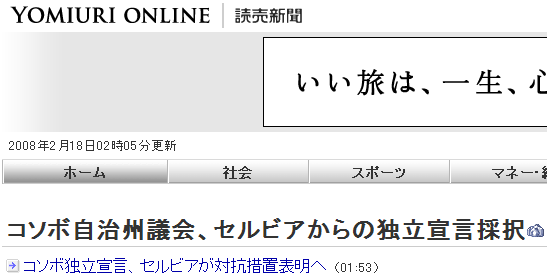
コソボ = Kosovo, 独立 = independence
In Taiwan
United Daily News

陳冠希 = Edison Chen
China Times

A political gossip related to the presidential election
Liberty Times

Unregistered helicopter "handcuffed"
Apple Daily

建仔 = 王建民 = Chien-Ming Wang
TVBS
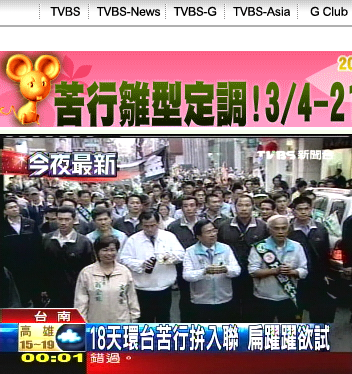
入聯 = to join the UN
SET
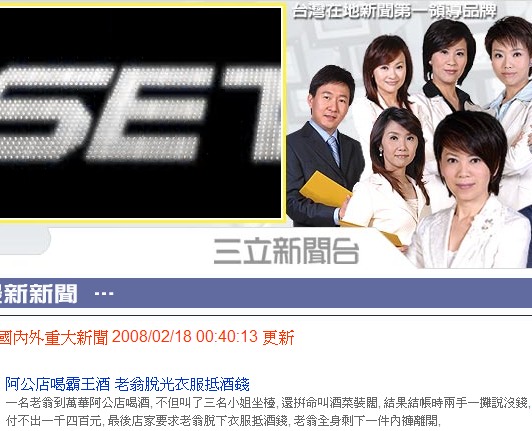
An old man (grandpa) spent a night in a night club with no money at all. He had to strip and leave all clothes as collateral.
CTI

Just a "real time" news ticker. No sign of Kosovo.
Eastern Television
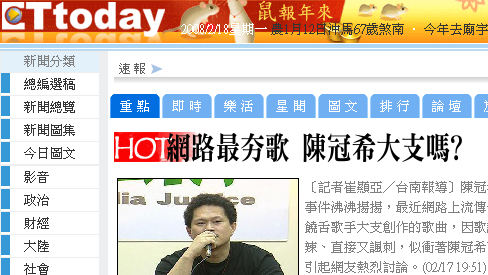
陳冠希 = Edison Chen
Era News

Drunk man hit mom
Formosa TV News

錯誤 = error
BBC News

Financial Times

People's Daily

科索沃 = Kosovo, 独立 = independence
CNN

Le Monde

Yomiuri Shimbun

コソボ = Kosovo, 独立 = independence
In Taiwan
United Daily News

陳冠希 = Edison Chen
China Times

A political gossip related to the presidential election
Liberty Times

Unregistered helicopter "handcuffed"
Apple Daily

建仔 = 王建民 = Chien-Ming Wang
TVBS

入聯 = to join the UN
SET

An old man (grandpa) spent a night in a night club with no money at all. He had to strip and leave all clothes as collateral.
CTI

Just a "real time" news ticker. No sign of Kosovo.
Eastern Television

陳冠希 = Edison Chen
Era News

Drunk man hit mom
Formosa TV News

錯誤 = error
Thursday, February 14, 2008
Edison Chen sex photo incident — Part 1

Edison Chen
Cecilia Cheung
Gillian Chung
Bobo Chan
Hong Kong Discuss Forum
This makes me remember another thing. A student was raped, and the school expelled the student in the name of "damaging the school's reputation". This is preposterous. These examples expose a distorted belief in this society. That is if a criminal activity involves sex, then the victim is also questionable.
These celebrities don't need to apologize. They have done nothing wrong. They should be angry and condemn. This incident is in the same class as leaked private financial or medical records.
See also
Friday, January 18, 2008
TWY
I think the translation of the Taiwanese currency should be "yuan", not "dollar". The symbol should be ¥ and not $.
Why is "圓" (yuan) sometimes translated as "dollar" (e.g. Hong Kong dollar), "dollar" translated as "圓" (United States dollar in Chinese)? It is not without reasons. In late 19th century and early 20th century, the world was divided into a handful of monetary regions. The dollar, peso, yuan, won, yen regions can be considered as one because one of such unit was defined as approximately 27 grams of 90% pure silver. These countries gradually became unable to sustain silver standard or gold standard, and abandoned the standards around World War I. But the names of the currency units remained unchanged, for the most part. It was a chaotic period between 1911–1949 in Mainland China in terms of monetary history. Warlords were everywhere, and new banknotes were issued almost every year. When the character "圓" was printed on the front side, sometimes English translation with "yuan" was printed on the back, sometimes with "dollar". Yuan was more frequent than dollar. Therefore, I've proven that 圓 = yuan = dollar.
 Then why do I still advocate the use of yuan? Right now the currency unit of Mainland China, South Korea, and Japan are all cognates of the character 圓 (yuan). And they are respectively transliterated as "yuan", "won", and "yen", spelled as they are spoken. The fact that Hong Kong's 圓 is translated as dollar is because it was a British colony. However, Macau's 圓 is not translated yuan or dollar. It is "pataca" because pataca is the Portuguese word for peso. Taiwan was never colonized by an English speaking country in modern time. There is no reason to use the word "dollar". So we should use "yuan".
 In addition, English has almost never been printed on banknotes since the issuance of the Taiwanese (old) "dollar" in 1946. But the first two series of the new Taiwanese "dollar" after 1949, the vertical series, had English translation with "YUAN" on the back. What else can be more official than banknotes? So my proposal is not without precedent.
If we were to use "yuan", then the symbol should be ¥.
Unfortunately, the ROC government in Taiwan, in recent decades, disregards the precedent of yuan. English documents and web pages use "dollar". Even the folder of the 1999 commemorative banknote for the 50th anniversary of the issuance of the new Taiwanese "dollar/yuan" had the word "dollar". This also exposes the ignorance of standardization in the Taiwanese society.
Taiwanese yuan, TW¥.
Why is "圓" (yuan) sometimes translated as "dollar" (e.g. Hong Kong dollar), "dollar" translated as "圓" (United States dollar in Chinese)? It is not without reasons. In late 19th century and early 20th century, the world was divided into a handful of monetary regions. The dollar, peso, yuan, won, yen regions can be considered as one because one of such unit was defined as approximately 27 grams of 90% pure silver. These countries gradually became unable to sustain silver standard or gold standard, and abandoned the standards around World War I. But the names of the currency units remained unchanged, for the most part. It was a chaotic period between 1911–1949 in Mainland China in terms of monetary history. Warlords were everywhere, and new banknotes were issued almost every year. When the character "圓" was printed on the front side, sometimes English translation with "yuan" was printed on the back, sometimes with "dollar". Yuan was more frequent than dollar. Therefore, I've proven that 圓 = yuan = dollar.
 |  |
| 圓 | yuan ↑ ↓dollar |
 |  |
 Then why do I still advocate the use of yuan? Right now the currency unit of Mainland China, South Korea, and Japan are all cognates of the character 圓 (yuan). And they are respectively transliterated as "yuan", "won", and "yen", spelled as they are spoken. The fact that Hong Kong's 圓 is translated as dollar is because it was a British colony. However, Macau's 圓 is not translated yuan or dollar. It is "pataca" because pataca is the Portuguese word for peso. Taiwan was never colonized by an English speaking country in modern time. There is no reason to use the word "dollar". So we should use "yuan".
 In addition, English has almost never been printed on banknotes since the issuance of the Taiwanese (old) "dollar" in 1946. But the first two series of the new Taiwanese "dollar" after 1949, the vertical series, had English translation with "YUAN" on the back. What else can be more official than banknotes? So my proposal is not without precedent.
If we were to use "yuan", then the symbol should be ¥.
Unfortunately, the ROC government in Taiwan, in recent decades, disregards the precedent of yuan. English documents and web pages use "dollar". Even the folder of the 1999 commemorative banknote for the 50th anniversary of the issuance of the new Taiwanese "dollar/yuan" had the word "dollar". This also exposes the ignorance of standardization in the Taiwanese society.
Taiwanese yuan, TW¥.
Wednesday, January 16, 2008


Subscribe to:
Posts (Atom)