Showing posts with label Technology. Show all posts

Monday, November 08, 2010

The Chronicle (Drama) of Mobile 2010

This chronicle is *NOT* to document important technological break throughs that matters to the consumers in 2010, but to record the dog-fight between these tech companies from the eyes of someone who follows tech news.

This article is U.S.-centric, and the dates are in a U.S. time zone unless specified otherwise. Even with my best effort, the dates may still be off by a day or two.

  • 1/5 – The Nexus One is released, along with Android 2.1 (Eclair). Multi-touch was not available and it is believed to be a gentlemen's agreement between Google and Apple.

  • 2/2 – Android 2.1 gets an update with multi-touch.

  • 2/16 – Google CEO Eric Schmidt says 60,000 Android devices are activated per day.

  • 3/2 – Apple sues HTC, the manufacturer that makes the Nexus One and many other Android devices for 20 patents. It is speculated to be a retaliation against Android's update with multi-touch.

  • 3/10 – ComScore reports that Apple has 25.1% of the market share in the U.S. in terms of 3-month average ending Jan. 2010, while Google has 7.1%, and RIM has 43.0%.

  • 4/5 – ComScore reports that Apple has 25.4% of the market share in the U.S. in terms of 3-month average ending Feb. 2010, while Google has 9.0%, and RIM has 42.1%.

  • 4/8 – iOS 4 announced.

  • 4/8 – Daring Fireball blogger John Gruber points out that article 3.3.1 of the iOS4 SDK license agreement basically rejects Flash or Adobe Air on iOS 4.

  • 4/12 – Microsoft unveils KIN.

  • 4/15 – Apple App Store rejects Pulitzer-Winning Satirist Mark Fiore's app.

  • 4/16 – Millennial Media, a Mobile ad network, reveals that iOS has 70% share of impressions, while Android has 6%, and RIM has 14% in the previous month.

  • 4/17 – Engadget reported an iPhone 4 prototype.

  • 4/19 – Gizmodo reported the lost iPhone 4 prototype. For some reason, media direct their attention at Gizmodo and not Engadget.

  • 4/19 – Gizmodo reported how they obtained the iPhone 4 prototype that originated from Gray Powell, an Apple employee.

  • 4/19 – Apple formally acknowledges the lost iPhone 4 prototype is their property and demands it back from Gizmodo. Gizmodo complies.

  • 4/19 – Apple CEO Steve Jobs allegedly says in an email, "Folks who want porn can buy and [sic] Android phone."

  • 4/23 – Law enforcement raided Jason Chen's house. Chen is the Gizmodo editor who reported the iPhone 4 prototype.

  • 4/26 – Motorola plans to use Skyhook's XPS (a location software) instead of Google's.

  • 5/7 – Nokia sues Apple over iPad and iPhone-related patents.

  • 5/10 – NPD survey shows that in Q1 2010 in the U.S., Android has 28% U.S. market share, Apple has 21%, and RIM has 36%.

  • 5/12 – HTC counter sues Apple.

  • 5/20 – Google Vice-President of Engineering Vic Gundotra quotes Andy Rubin, "if Google did not act, we faced a Draconian future, a future where one man, one company, one device, one carrier would be our only choice."

  • 5/20 – Android 2.2 (Froyo) and Google TV announced. Google says 100,000 Android devices are activated per day.

  • 5/20 – Millennial Media reveals that iOS has 62% share of impressions, while Android has 10%, and RIM has 17% in the previous month.

  • 6/7 – Steve Jobs announces iPhone 4 at WWDC 2010.

  • 6/18 – Millennial Media reveals that iOS has 48% share of impressions, while Android has 15%, and RIM has 19% in the previous month.

  • 6/15 – ComScore reports that Apple has 25% of the market share in the U.S. in terms of 3-month average ending Apr. 2010, while Google has 12.0%, and RIM has over 40%.

  • 6/23 – Andy Rubin says 160,000 Android devices are activated per day.

  • 6/23 – Apple sues HTC again.

  • 6/24 – iPhone 4 released.

  • 6/24 – iPhone 4 reception problem reported. Steve Jobs allegedly tells a complaining user "Just avoid holding it in that way."

  • 6/24 – Brian Maupin (tinywatchproductions) uploads an "iPhone4 vs HTC Evo" (NSFW) video on YouTube, featuring 2 cartoon characters with synthesized voice. Maupin also uploads an opposite video "HTC EVO vs iPhone4." Both videos become viral shortly. The former that bashes iPhone outpaces the latter that bashes EVO at a 5:1 ratio in terms of click rate.

  • 6/30 – Microsoft discontinues KIN.

  • 7/1 – Reports suggest that the end of KIN is a result of ugly workplace politics at Microsoft.

  • 7/1 – Best Buy, the employer of Brian Maupin, puts Maupin on suspension, which further contributes the viralness of the videos.

  • 7/6 – Best Buy decides not to fire Brian Maupin. But he decides not to take the job back.

  • 7/8 – ComScore reports that Apple has 24.4% of the market share in the U.S. in terms of 3-month average ending May 2010, while Google has 13.0%, and RIM has 41.7%.

  • 7/12 – Consumer Reports can't recommend the iPhone 4.

  • 7/14 – Paramount Pictures shows interest in hiring Brian Maupin.

  • 7/14 – Microsoft COO Kevin Turner says "It looks like the iPhone 4 might be their Vista."

  • 7/15 – Millennial Media reveals that iOS has 56% share of impressions, while Android has 11%, and RIM has 17% in the previous month.

  • 7/16 – At a emergency press conference, Steve Jobs says 1.7% of iPhone 4 were returned, compared to 6% of iPhone 3GS, the perceived signal drop is a result from a miscalculating formula, and Apple will be giving away free Bumpers. Apple also makes a web page that shows the signal drop problem also occurs on BlackBerry Bold 9700, HTC Droid Eris, Motorola Droid X, Nokia N97 mini, Samsung Omnia II, and its own iPhone 3GS.

  • 7/16 – RIM's co-CEO's Mike Lazaridis and Jim Balsillie states "Apple's attempt to draw RIM into Apple's self-made debacle is unacceptable. … During that time, RIM has avoided designs like the one Apple used in the iPhone 4 and instead has used innovative designs which reduce the risk for dropped calls."

  • 7/17 – Nokia says "Nokia has invested thousands of man hours in studying how people hold their phones and allows for this in designs, for example by having antennas both at the top and bottom of the phone and by careful selection of materials and their use in the mechanical design."

  • 7/17 – HTC's spokesman Eric Lin says the support rate of Droid Eris is approximately .016% of customers.

  • 7/19 – Samsung defends their Omnia 2 phone "Reception problems have not happened so far, and there is no room for such problems to happen in the future."

  • 8/4 – Eric Schmidt says 200,000 Android devices are activated per day.

  • 8/5 – NPD survey shows that in Q2 2010 in the U.S., Android has 33% U.S. market share, Apple has 22%, and RIM has 28%.

  • 8/6 – HP CEO Mark Hurd resigns for inappropriate business conduct found in an investigation into a claim of sexual harassment. (I know this isn't mobile-related.)

  • 8/9 – Oracle CEO Larry Ellison comments on Hurd's resignation, "The H.P. board just made the worst personnel decision since the idiots on the Apple board fired Steve Jobs many years ago."

  • 8/12 – Oracle sues Google over Java patent infringement in Android.

  • 8/18 – Millennial Media reveals that iOS has 55% share of impressions, while Android has 19%, and RIM has 16% in the previous month.

  • 8/27 – Microsoft co-founder Paul Allen sues Apple, Google, Facebook, AOL, eBay, Netflix, Yahoo!, Staples, OfficeMax, Office Depot, and YouTube over patents

  • 9/1 – Steve Jobs announces the 2nd generation of Apple TV

  • 9/2 – Samsung Galaxy Tab announced in Berlin. Galaxy Tab runs on Android 2.2 and a 7" display.

  • 9/6 – Oracle hires Mark Hurd.

  • 9/6 – HP sues Oracle over hiring Mark Hurd.

  • 9/9 – Apple relaxes its restrictions on iOS app code.

  • 9/15 – ComScore reports that Apple has 23.8% of the market share in the U.S. in terms of 3-month average ending Jul. 2010, while Google has 17.0%, and RIM has 39.3%.

  • 9/16 – Skyhook sues Google for strong-arming of Motorola.

  • 9/28 – Millennial Media reveals that iOS has 48% share of impressions, while Android has 26%, and RIM has 19% in the previous month.

  • 10/1 – Microsoft sues Motorola because of Android.

  • 10/3 – Microsoft CEO Steve Ballmer says Android isn't really free.

  • 10/6 – Motorola sues Apple.

  • 10/6 – ComScore reports that Apple has 24.2% of the market share in the U.S. in terms of 3-month average ending Aug. 2010, while Google has 19.6%, and RIM has 37.6%.

  • 10/11 – Windows Phone 7 announced.

  • 10/18 – Apple announced financial results for its fiscal Q4 2010 (ended 9/25). Steve Jobs says iPhone sale surpasses RIM 14.1 to 12.1 millions, Android's openness is disingenuous, 7" tablet is an awkward size, and 275,000 iOS devices are activated per day. Jobs also quotes TweetDeck's statistics to show the alleged fragmentation problem of Android.

  • 10/18 – Andy Rubin tweets, "the definition of open: "mkdir android ; cd android ; repo init -u git://android.git.kernel.org/platform/manifest.git ; repo sync ; make""

  • 10/18 – RIM co-CEO Jim Balsillie says, "For those of us who live outside of Apple’s distortion field, we know that 7″ tablets will actually be a big portion of the market and we know that Adobe Flash support actually matters to customers who want a real web experience. ... We think many customers are getting tired of being told what to think by Apple."

  • 10/19 – Iain Dodsworth, one of the two developers of TweetDeck, tweets "Did we at any point say it was a nightmare developing on Android? Errr nope, no we didn't. It wasn't."

  • 10/19 – Joe Hewitt, developer of Firefox and FireBug, says that even Android is not "open" by Firefox's or Linux's standard.

  • 10/19 – Millennial Media reveals that iOS has 46% share of impressions, while Android has 29%, and RIM has 19% in the previous month.

  • 10/20 – At "Back to the Mac" event, the next generation of MacBook Air was announced. Shortly, people discovered that the new MacBook Air does not have Adobe Flash pre-installed.

  • 10/21 – Android and Me reports a rumor that Samsung will have a Google-experience phone in 2010.

  • 10/22 – Giant Gingerbread (Android 2.3) man arrives at Google HQ.

  • 10/28 – Gizmodo claims that Samsung "Nexus Two" is real.

  • 10/30 – Apple counter sues Motorola.

  • 11/1 – Samsung says the Nexus Two rumor "simply not true."

  • 11/1 – NPD survey shows that in Q3 2010 in the U.S., Android has 44% U.S. market share, Apple has 23%, and RIM has 22%.

  • 11/2 – T-Mobile U.S.A. launches their 4G campaign, mocking A&T and iPhone 4 at the same time. Despite not meeting ITU's specification, most carriers in the U.S.A. still call their new service "4G".

  • 11/2 – Sprint responded T-Mobile's 4G campaign, "Halloween is over–it’s time for T-Mobile to stop dressing up like their favorite super hero–Sprint 4G."

  • 11/3 – ComScore reports that Apple has 24.3% of the market share in the U.S. in terms of 3-month average ending Sep. 2010, while Google has 21.4%, and RIM has 37.3%.

  • 11/3 – AT&T responds to T-Mobile's commercial, "T-Mobile's claims about 4G are based on the same HSPA+ technology we have deployed to 180 million people today, more than T-Mobile’s reported 140 million, and we’ll have it rolled out to 250 million people by the end of this month, substantially more than the 200 million T-Mobile says it will have by year-end."

  • 11/4 – T-Mobile continues the offensive on Facebook, "Hey AT&T – It is easy for us to be proud when we have the 4G network to back it up. We challenge you to show us any data speeds on an AT&T iPhone that can top the speed on T-Mobile’s myTouch 4G. But you don’t have to take our word for it. Check out these amazing speed test screenshots from our T-Mobile fans: http://goo.gl/P0wk3"

  • 11/4 – At&T replies to T-Mobile on Facebook with the same statement said on the day before.

  • 11/9 – Microsoft sues Motorola.

  • 11/11 – Motorola sues Microsoft.

  • 11/11 – Numerous rumors about the alleged Nexus S explode this day.
    • BestBuy website leak suggests Samsung Nexus S on T-Mobile.
    • Pictures of a physical Nexus S leak.
    • BestBuy internal document leak suggests Samsung Nexus S on T-Mobile.
    • Samsung "flagship device" (not Nexus S) coming in Feb 2011. Gingerbread.
    • Pictures shot with Samsung GT-i9020 (according to EXIF) found on Flickr.
    • First Nexus S was scrapped in favor of a new dual-core version.

  • 11/15 – Eric Schmidt shows the Nexus S.

  • 11/18 – Millennial Media reveals that iOS has 37% share of impressions, while Android has 37%, and RIM has 20% in the previous month.

  • 11/18 – Apple Co-founder Steve Wozniak is reported to say that Android will dominate the smartphone market.

  • 11/18 – Steve Wozniak says his pervious statement was quoted out of context.

  • 11/18 – Microsoft Kin ONEm and TWOm are back with lower prices.

  • 11/27 – Apple bans a Danish Android magazine app from the App Store.

  • 12/1 – Verizon announces their "4G" (LTE) network. On the same day, T-Mobile reiterates that T-Mobile has "America’s Largest 4G Network".

  • 12/3 – ComScore reports that Apple has 24.6% of the market share in the U.S. in terms of 3-month average ending Oct. 2010, while Google has 23.5%, and RIM has 35.8%.

  • 12/6 – Nexus S is officially announced.

  • 12/14 – Millennial Media reveals that iOS has 38% share of impressions, while Android has 38%, and RIM has 19% in the previous month.

  • 12/16 – Nexus S is available from Best Buy in the U.S.

  • 1/6/2011 – ComScore reports that Apple has 25.0% of the market share in the U.S. in terms of 3-month average ending Oct. 2010, while Google has 26.0%, and RIM has 33.5%.

  • 1/13/2011 – Millennial Media reveals that iOS has 32% share of impressions, while Android has 46%, and RIM has 16% in the previous month.


Sue graph. A→B denotes A suing B.

Actually, similar graphs have been circulating on the Internet for some time. See also

ComScore data are market shares in the U.S. in the past 3 months

Millennial Media data are shares of ad impression in the U.S. in the previous month

NPD data are shares of purchases in a given quarter

Monday, March 29, 2010

Megapixel Myth

High megapixel value equates to better quality? Megapixel = quality?

If you search for "megapixel myth" on a search engine, you'll find many websites on this subject. In fact, there's an entire website dedicated to this. But most of these websites are text only, and full of technical jargons. Therefore, I decided to bust the myth with photos and simple language.

The devices I used to perform the comparison are Canon SD940 IS (a.k.a. Canon IXUS 120 in Asia and Europe) and the camera on the Nexus One phone. Canon has 12 MPs, set to 5 MPs during testing; Nexus is 5 MP.

Canon SD940 IS (IXUS 120)Nexus One


Below are two photos taken by the two cameras at the same spot, almost at the same time:

↓Canon SD940 IS (IXUS 120)↓
↑Canon SD940 IS (IXUS 120)↑

↓Nexus One↓
↑Nexus One↑


When reduced to this small, both look great. But if you view them at their original size, that is using each pixel on your screen to display one pixel from the photos, we get these results:

↓Canon SD940 IS (IXUS 120), 100%↓
↑Canon SD940 IS (IXUS 120), 100%↑

↓Nexus One, 100%↓
↑Nexus One, 100%↑


Obviously, Canon the real camera has much better quality. If enlarged at 300%, the contrast is even greater:

↓Canon SD940 IS (IXUS 120), 300%↓
↑Canon SD940 IS (IXUS 120), 300%↑

↓Nexus One, 300%↓
↑Nexus One, 300%↑

Due to the web page layout, I cannot give you a more comprehensive comparison within the text. So I provide this side-by-side comparison. Click to enlarge and see the side-by-side:


I was very forgiving to the Nexus One by testing under broad daylight. The result would be catastrophic if under low light:

↓Canon SD940 IS (IXUS 120), hand held, no flash↓
↑Canon SD940 IS (IXUS 120), hand held, no flash↑

↓Nexus One, hand held, the output would be the same with or without flash↓
↑Nexus One, hand held, the output would be the same with or without flash↑


You might be asking, "if MP doesn't mean quality, what does it mean?" It measures the size of the photo. It is the number of dots that make up the photo. A 5 MP photo is composed by 5 million dots. When a camera takes a photo, the following happens
  • Light ray shoots off from the object
  • These light rays enter the camera's lens
  • Lens causes refraction or reflection
  • After refraction, the light arrives at the sensor
  • You can imagine that a 5 MP camera has 5 million units of sensors, where each one must determine how much red, green, and blue is hitting itself

If the lens is bad, the number of MPs of the sensor is irrelevant because the sensor is behind the lens. If you want image quality, the basic requirements are
  1. Good lens, no faulty refraction
  2. High MP value
  3. The photosensor must be accurate about the color and brightness

Therefore, high MP value is a necessary condition, but not the only condition. If you want to learn about the image quality, the only way is to judge from sample images from an objective web site.

How many MPs are enough? It depends on your ultimate output.
  • Viewed on a 19" screen → 1.3 MPs
  • 4×6" print (10×15 cm) → 2.2 MPs
  • Viewed on a 26" screen → 2.3 MPs
  • A4 size print (29.7×21 cm) → 8.4 MPs
  • 40×30 cm print →16.7 MPs

If a camera cannot be judged by a simplified number, can you judge a person by number? Can you evaluate a student by a standardized test score? Can you say how "achieved" a person is by his or her salary?

Thursday, March 13, 2008

Region coding for video or game

I've wanted to complain about this long time ago. DVD, Blu-ray, or console game region coding is wrong.

I'm no economist, but there's one thing I remember from my economics class in college. "If a certain product can be used globally (e.g. medicine), and there are forces that prohibit the import/export of such product, then the following are the results compared to a completely free market.
  • Consumers are hurt
  • Producers gain extra benefit
  • If we combine the utility (happiness) of consumers and producers, the total utility is still less than that of a free market"
If you argue that medicine should be highly regulated, I can't deny that. But movies? Why can't a German buy an American movie while visiting the U.S., and bring the movie back and watch it at home? Or a South African wants to send a gift to someone in India? Region coding is just a scheme artificially created by big corporations to maximize profits. One key ingredient of profit maximization is price discrimination. Price discrimination is a blatant violation of consumers' right. Why is it that a customer is forced to buy a product from his/her region when and if there's a substitute that is close enough and cheaper from another region? If a customer is willing to pay for extra shipping cost and wait for extra shipping delay, who are we to take away his/her right to buy from other places? Yes, I know most things are priced differently everywhere. "Price discrimination" is more than "different prices". It's "difference price + you can't buy from other places". It is that I'm against.

Protection against piracy they say? How does this artificial barrier increase the difficulty for someone in region 1 to copy a region 1 disk, where the clone is also region 1? In practice, a simple PC nowadays can make region-free copies from a single-region disk! Region coding does not make piracy more difficult.

Some people would say "what's wrong with a company trying to make money? Isn't it their primary purpose?" Even so, companies are still members of this society. There are morals and laws to be followed. Everybody would agree that false advertisement is wrong, therefore laws are made so. Region coding is also wrong. The inability to watch/play something from another region is not a result of some natural economic or technological difficulty (e.g. shipping cost, or a DVD can't be read by a CD-ROM). The difficulty is intentionally created by people. The artificial barrier benefits a small number of corporations, at a greater cost for the consumers. This "rob from the poor, give to the rich". This can't be right. Furthermore, what pisses me off the most is the fact that I hear this kind of argument from consumers themselves! Why are you defending the other side while economists already prove that it's bad for the society?

Video and game region coding
  • costs more to the consumers than benefits to the producers (the society as a whole incurs loss)
  • does not prevent piracy
  • is a scheme cooked up by big corporation no other than profit maximization

See also


Thursday, December 27, 2007

Why is organizing photos a baffling ordeal?

If you know me, you know that I like to take photos. I have two cameras, one of which is compact enough to fit in my pocket so that I can capture rare or interesting things at the spot. I know that people often wonder "when can I get your pictures?". Organizing photos is a demanding task for me. It's not just a simple matter of transferring files from the memory card to the hard drive. There are many other little tasks, and I will explain why

Photos

Exif

JPEG files produced by digital cameras usually contain Exif metadata (data about data). What it records includes a number of things such as time, aperture, shutter speed, orientation, and other camera settings.

Orientation

While taking photos with portrait orientation, Canon cameras still store the photo in landscape orientation, but flip the orientation information in Exif. As a result, not all software recognizes this method of orientation. Photoshop, ACDSee, Firefox, and IE don't recognize Exif orientation. So for maximum compatibility, I have to rotate these photos manually. There are many software that can do this. But most destroy or partially destroy the original Exif information. The only one that does not, at least for Canon-camera-captured photos, is Canon's own ZoomBrowser application.

Timestamp

As I said, Exif includes timestamp. The file system, NTFS in my case, also records timestamps. NTFS records the timestamps in UTC internally, and displays with user's time zone setting. When I change my system's time zone, the timestamps on my file system appear to shift as well. But this is not the case for the timestamps in Exif, as it is part of the file. I leverage this difference to indicate where the photo was taken, at least in what time zone. I make sure that the timestamp in Exif is the local time where the photo was taken, while the NTFS timestamp is in the time zone of my system. But wait, why am I telling you this? How does this impact my organizing photos? Rotating photos changes the NTFS timestamps. So I have to correct the NTFS timestamps after rotation using ACDSee.

Videos

Canon cameras capture videos in Motion JPEG, a compression scheme that doesn't really compress much. Therefore, videos must be recompressed. And my choice of codec is Xvid. Here are the steps that I must perform to convert MJPEG to Xvid.
  • Extract the audio (wav file) from the original video
  • Convert the wav file to mp3
  • Encode the video with Xvid as the video codec, and the mp3 as audio
  • Inspect the quality of the new video (watch two files side by side)
  • Validate that it is indeed encoded with Xvid and mp3
  • Restore the original time stamp
  • Delete the old copy and rename the new copy

Publishing

There are thousands of websites that provide photo service. But I'm not satisfied with any of them. The problem? Size and scale. These websites usually shrink the image size. If the size can be preserved, then most likely they limit your upload capacity. If you know me, then you would know that size and completeness is a big deal to me. There are no free online solutions for 9GiB of 8600+ files. What better place is there than my own hard drive? So I used JAlbum to generate HTML and thumbnails, then I host them with Apache. This process is also time consuming (computer time). I'm looking for alternatives.

Text description

People often ask me why I don't add text to the photos. I could, even with the complex process described above. But it's not the action of adding text that takes most of the time. It's the time spent on deciding what to write. If I were to write anything at all, I must look up the right references, provide background stories, and most important of all, write them in both Chinese and English. I tried this with my trip to Paris and England. And it proved to be a time consuming task as well.

Since it is a complicated process, it is best for me to accumulate the photos for a while and do them in batch. I can achieve economies of scale by performing the same tasks repeatedly in a shorter amount of time.

Tuesday, October 30, 2007

Free My Phone

One day I read this article written by Walt Mossberg, the principal technology columnist for the Wall Street Journal, on October 21, 2007 about the ridiculous cell phone market system in the U.S.. The original article is here (contains video). For your convenience, I've added Wikipedia links here.


Suppose you own a Dell computer, and you decide to replace it with a Sony. You don’t have to get the permission of your Internet service provider to do so, or even tell the provider about it. You can just pack up the old machine and set up the new one.

Now, suppose your new computer came with a particular Web browser or online music service, but you’d prefer a different one. You can just download and install the new software, and uninstall the old one. You can sign up for a new music service and cancel the old one. And, once again, you don’t need to even notify your Internet provider, let alone seek its permission.

Oh, and the developers of such computers, software and services can offer you their products directly, without going through the Internet provider, without getting the provider’s approval, and without giving the provider a penny. The Internet provider gets paid simply for its contribution to the mix: providing your Internet connection. But, for all practical purposes, it doesn’t control what is connected to the network, or carried over the network.

This is the way digital capitalism should work, and, in the case of the mass-market personal-computer industry, and the modern Internet, it has created one of the greatest technological revolutions in human history, as well as one of the greatest spurts of wealth creation and of consumer empowerment.

So, it’s intolerable that the same country that produced all this has trapped its citizens in a backward, stifling system when it comes to the next great technology platform, the cellphone.

A shortsighted and often just plain stupid federal government has allowed itself to be bullied and fooled by a handful of big wireless phone operators for decades now. And the result has been a mobile phone system that is the direct opposite of the PC model. It severely limits consumer choice, stifles innovation, crushes entrepreneurship, and has made the U.S. the laughingstock of the mobile-technology world, just as the cellphone is morphing into a powerful hand-held computer.

Whether you are a consumer, a hardware maker, a software developer or a provider of cool new services, it’s hard to make a move in the American cellphone world without the permission of the companies that own the pipes. While power in other technology sectors flows to consumers and nimble entrepreneurs, in the cellphone arena it remains squarely in the hands of the giant carriers.

The Soviet Ministry Model

That’s why I refer to the big cellphone carriers as the “Soviet ministries.” Like the old bureaucracies of communism, they sit athwart the market, breaking the link between (the producers of goods and services) and (the people who use them).

To some extent, they try to replace the market system, and, like the real Soviet ministries, they are a lousy substitute. They decide what phones can be used on their networks and what software and services can be offered on those phones. They require the hardware and software makers to tailor their products to meet the carriers’ specifications, not just so they work properly on the network, but so they promote the carriers’ brands and their various add-on services.

Let me be clear: Any company that spends billions to build and maintain a wireless network deserves to be paid for its use, and deserves to make a profit and a return for its shareholders. Not only that, but companies like Verizon Wireless or AT&T Inc. should be free to build or sell phones or software or services.

What Is Needed

But, in my view, they shouldn’t be allowed to pick and choose what phones run on their networks, and what software and services run on those phones. We need a wireless mobile device ecosystem that mirrors the PC/Internet ecosystem, one where the consumers’ purchase of network capacity is separate from their purchase of the hardware and software they use on that network. It will take government action, or some disruptive technology or business innovation, to get us there.

To my knowledge, only one phone maker, Apple Inc., has been permitted to introduce a cellphone with the cooperation of a U.S. carrier without that carrier having any say in the hardware and software design of the product. And that one example, the iPhone, was a special case, because Apple is currently the hottest digital brand on earth, with its own multibillion-dollar online and physical retail network.

Even so, Apple had to make a deal with the devil to gain the freedom to offer an unimpaired product directly to users. It gave AT&T exclusive rights to be the iPhone’s U.S. network for an undisclosed period of years. It has locked and relocked the phone to make sure consumers can’t override that restriction. This arrangement reportedly brings Apple regular fees from AT&T, but penalizes people who live in areas with poor AT&T coverage.

Apple has also, so far, barred users from installing third-party programs on the iPhone, though the company announced last week it will open the phone to such programs early next year. (Web-based iPhone programs–those that run inside the Web browser–have been available from day one.)

These restrictions have rubbed some of the luster off the best-designed handheld computer ever made.

A few other “smart phones” sold primarily to businesses have been freer of carrier restrictions on third-party software and services than typical cellphones. But even these handsets, such as Palm Trēos, Windows Mobile devices, and BlackBerrys, have been partly crippled by carriers in some cases.

As a technology reviewer, I have met with multiple small companies that had trouble getting their programs onto consumers’ phones without the permission of the carriers; getting that permission often requires paying the carriers. Sure, there are some clumsy workarounds that can evade the carrier barrier, but it’s nothing like the ability small software companies have had for decades to offer their products for installation on Windows or Macintosh computers.

We also need much greater portability of phone hardware. Because the federal government failed to set a standard for wireless phone technology years ago, we have two major, incompatible cellphone technologies in the U.S. Verizon Communications Inc. and Sprint Nextel Corp. use something called CDMA. AT&T and Deutsche Telekom AG's T-Mobile use something called GSM. Except for a couple of oddball models, phones built for one of these technologies can’t work on the other. So that limits consumer choice and consumer power. If you want to switch from AT&T to Verizon, you have to swallow the cost of a new phone.

But the problem is even worse. The government didn’t require the CDMA companies to include a removable account-information chip, called a SIM card, in their phones. So, unlike people with GSM phones, Sprint and Verizon customers can’t keep their phones if they switch between the two carriers, even though they use the same basic technology. And, the government allows the GSM carriers to “lock” their phones, so a SIM card from a rival carrier won’t work in them, at least for a period of time. Techies can sometimes figure out how to get around this, but average folks can’t.

The carriers defend these restrictions partly by pointing out that they subsidize the cost of the phones in order to get you to use their networks. That’s also, they say, why they require contracts and charge early-termination fees. Without the subsidies, they say, that $99 phone might be $299, so it’s only fair to keep you from fleeing their networks, at least too quickly.

But this whole cellphone subsidy game is an archaic remnant of the days when mobile phones were costly novelties. Today, subsidies are a trap for consumers. If subsidies were removed, along with the restrictions that flow from them, the market would quickly produce cheap phones, just as it has produced cheap, unsubsidized versions of every other digital product, from $399 computers to $79 iPods.

The Federal Communications Commission is selling some new wireless spectrum that will supposedly lead to fewer restrictions for technology companies and consumers, but it’s far from certain that the carriers, with their legions of lobbyists and lawyers, will allow such a new day to dawn. Google Inc. is making noises about trying to bust open the cellphone prison, with new software and services, but that’s no sure bet either.

Remember Landlines?

We’ve been through this before in the U.S., though many younger readers may not recall it.

Up until the 1970s, when the federal government intervened, you weren’t allowed to buy your own landline phone, and companies weren’t able to innovate, on price or features, in making and selling phones to the public. All Americans were forced to rent clumsy phones made by a subsidiary of the monopoly phone company, AT&T, which claimed that, unless it controlled what was connected to its network, the network might suffer.

Well, the government pried that market open, and the wired phone network not only didn’t collapse, it became more useful and versatile, allowing, among other things, cheap connections to online data services.

I suspect that if the government, or some disruptive innovation, breaks the crippling power that the wireless carriers exert today, the free market will deliver a similar happy ending.

Email me at mossberg@wsj.com.

Wednesday, August 22, 2007

Indomie Mi Goreng

Indomie Mi Goreng has a MySpace page! (Scroll down to see two people eating 4 packs each.)

Tuesday, July 10, 2007

A tale of souls and swords, and ridiculous breasts

...And it wouldn't be a Soul Calibur without some lass with crazy huge mammaries. Though in this installment, Namco has opted to give the already impressively big Ivy a next-gen boob boost. You can see the difference below. And what's with that costume, anyway? More...

Thursday, June 28, 2007

Wednesday, June 20, 2007

Safari for Windows

Safari for Windows was released on 2007-06-11. It has some serious problem with internationalization. It doesn't display Indic scripts.

Safari


Firefox


In addition, when a page contains mixture of traditional and simplified Chinese characters, two different fonts are used. For the example on the right, the simplified characters 维 and 历 are rendered in Ming font, while the traditional characters (or characters common to both systems) are rendered in sans-serif. Apple can probably get away with internationalization because their website says so.

Usability issue: Hotkey Ctrl-+, Ctrl--, and Ctrl-0 for enlarging or shrinking font size don't work. Pressing enter after clicking on a radio button doesn't submit the form. It crashed within 5 minutes I started using, and continue to crash later.

Google Maps

Try searching for the driving direction from Boston to Paris on Google Maps.

Blue Screen of Death

Seoul Subway


New York Subway


Blue Screen of Death

Thursday, May 24, 2007

Google Earth Taipei road map

Google Earth now has Taipei road map!! Including lanes (巷) and alleys (弄)!


So does Google Maps. It also has MRT routes.

Sunday, April 29, 2007

Gapminder

People usually want to live in the comfort of their own belief and stereotypes. And media, to attract more audience, would fall into the vicious cycle of presenting exaggerated stories, making stereotypes, and back and forth. In an age when the amount of information is increasing exponentially, we must not only read carefully edited news, but also the raw data. Some of the latter task can be aided by technologies now.

Hans Rosling's 21 min. talk at the 2006 TED Conference in Monterey, CA highlighting novel ways of presenting global statistics.

Search statistics through Google and watch it move with Gapminder. Google Subscribed Links makes it possible to search deep into Gapminder's moving graphs visualizing world development. Spring 2006.
Subscribe
Go straight to the graph


A presentation for UNDP Human Development Report 2005 in English and some other languages. Human Development Trends was produced in 2005. Available in English, Danish, Finnish, French, German, Hungarian, Lithuanian, Norwegian, Russian, Spanish & Swedish.
Download


Related links

Friday, April 27, 2007

Wide screen

In recent years, there is an increasing trend to advertise "wide screen" on laptops. It seems that a wider screen shows more than a narrow screen. But it's all relative. One can say that a wide screen is a short screen, and a narrow screen is a tall screen. And I personally prefer tall screen over wide screen on a laptop. Why? The price of a LCD display is approximately proportional to its size and the number of pixel. For example, Dell 2007FP (20.1", 1600×1200 = 1.92 megapixels) is US$379 on PriceGrabber, and Dell 2007FWP (20.1", 1680×1050 = 1.764 megapixels) is US$369.95 on PriceGrabber. So if I'm paying roughly the same amount, I'd like to have as many pixels as possible. The number of pixels here is not really the simple product of the height and the width. It's how many are actually utilized. Most websites are built to be 800×600-friendly, and most sites have vertical scroll. If my screen width is larger than 800, then it is likely that I'm "wasting pixels" on the left and right, although enough websites are multi-resolution-friendly. Most blogs are fixed width. By the same token, many contemporary DVDs video have a aspect ratio of 1.85:1 or 2.35:1. On a screen that is 4:3 (or 1⅓:1), there would be black areas on the top and bottom. These are the two major cases where the pixels are wasted. And I have to ask myself, which one scenario is more common for myself? It's websites. When I'm reading a web page, what good is the extra 80 pixels on the horizontal axis, while I could have 150 extra pixels on the vertical axis, and possibly avoid some scrolling?

You may have a different use case. But you have to think about it for yourself. Marketing people do not have your best interest in mind.

Monday, February 12, 2007

Google Ditu

http://ditu.google.com/
Cannot search 重慶 (Chongqing in traditional characters)
Can search 重庆 (Chongqing in simplified)
Cannot search 台北 (Taipei) or 香港 (Hong Kong)
There is a path from Hangzhou to Shanghai
There is no path from Nanjing to Shanghai
It is politically correct on South Tibet and Aksai Chin

Tuesday, January 23, 2007

Technology news in Taiwan

I am tired of those so called "mainstream" print media in Taiwan. When they talk about "tech news", most of them are about the increase/decrease of production, revenue, and the up and down of stock prices. These are "tech industry news", which are more business than technology at the core. Indeed, those are useful information. And as media, they have the duty to report it. But not all readers are investors. On the contrary, most are consumers. The impact to consumers is usually briefly mentioned. Is this product like microwave oven, which will change the way we do things, or is it just a trendy thing? Is there any obvious short coming? Substitute? Cons and pros? You hardly see those.

This could be attributed to the manufacturer's state of mind that lasted for decades. Manufacturers do not need to worry too much about what the consumers want or need. All they need to take care of is the number: capital, income, expense. The challenge that Taiwanese firms face right now is not how to make things at a very cheap cost and with a superb quality. They've already achieved that. The challenge is to choose a path. They can continue their current course, and be the leader. Or they can sell their products directly to consumers, then in turn establish their brands. The latter would cause an immediate problem: their customers would become competitors instantly. It's too early to tell. I seem to deviate from the original topic too much.

Friday, January 19, 2007

Apple

Steve Jobs said that there will be more iPhone applications by the time it is released. Apple will control what applications make it onto the iPhone. He said "You don't want your phone to be like a PC. The last thing you want is to have loaded three apps on your phone and then you go to make a call and it doesn’t work anymore. These are more like iPods than they are like computers." While I believe that they have the best intention of providing better software, this strategy is totally a double edge sword. The reason why PC is still the dominating platform is not because Windows or the software that runs on it is so much better than those of Mac. It's because everyone can make PC hardware and the OS/software can be easily pirated. What's my point here? Openness. Although I am in no way demanding Apple to let everyone pirate their OS/product, but being open is absolutely important to a product like smart phones.

The example Steve gave could happen. But bad software will be eliminated by natural selection. Is Apple implying that smart phone users are not smart enough to make the selection so that the smart people at Apple will make the selection for the 10 million customers they anticipated to have? My phone is a Windows Mobile 5. If you press the on/off button, the touch screen will shut down and all inputs are locked. However, what they fail to do is to let the music continue being played when everything else is locked. I had to turn to a third party software. If Microsoft employs the same strategy, this software will probably never see daylight. It makes me wonder if Apple will reject a certain software because it will cannibalize its profit elsewhere (e.g. iTunes), hurt its beloved partner Cingular Wireless from AT&T (e.g. VoIP software like Skype), or some small utility that will expose iPhone's deficiency (like my personal example above).

Apple's lawyer team is cracking down blogs that provide links to screenshots of Windows Mobile skins that look like iPhone's in the name of copyright infringement. (another report). First, it is already questionable to take action against the skin. It is like McDonald's taking action against a small mom and pop's burger shop because the wrappers look too similar to McDonald's (while the burgers taste differently). Please, it is just a skin. Second, it is just beyond absurd to threaten a blogger who simply reported the thing. The blog doesn't even provide the skin itself.

If this is not for chilling effect, then what is it?

In addition to Cisco, LG is considering suing Apple for similar design. Now we know who has the habit of copying!

Taste your own medicine, Apple! (The same proverb in Chinese is "a taste of your own fruit" (自食其果), which gives it an extra pun!)

This is like when Intel tried to register a well established acronym (was it RAM, DRAM, or SDRAM, I don't remember) as a trademark so that everyone else can't use the name anymore (in favor of RDRAM). They tried to win by law instead of better products. Nobody uses RDRAM nowadays.

If you know me for years, you will know that my criticisms on Apple's products have been technical. From time to time, there are appraisals too. Now Apple just falls into the "uncool" category in my book.

I was contemplating buying an Apple's laptop. (In case you haven't noticed, I didn't use the proper product name because I'm afraid of legal trouble about trademark infringement!)

Tuesday, January 16, 2007

New technology

I hate when a new technology comes out, developers and designers spend additional resources with the new technology, just to mimic some imperfection of an old technology. This statement is best illustrated with examples

  • Some digital cameras make the noise that is similar to a mechanical shutter at the time of shooting. All the user needs is a confirmation that the picture is taken. A simple beep will do just fine. Now that someone needs to make/record/synthesize a sound file to mimic that. What's next? When I put in a new memory card, the camera will make the noise of film being scrolled?
  • There is a world clock widget in Apple's Dashboard. I am not against analog clocks on computers, but if you look closely at Apple's widget, when the second hand moves every second, it shakes back and forth a little before landing on the next second. This is a perfect example of the imperfection of a traditional analog clock. How does this reproduced inaccuracy enhance time measuring? What's next? A pendulum below the clock?
  • Cell phones show reception strength in bars, usually from 0 to 5 bars. I would guess that the actual measurement of the signal strength is a numeric value, but not from 0 to 5. So now the developers have to convert the strength to a 0 to 5 scale, and then draw bars on the screen with increasing sizes? Isn't it easier just to display a percentage number? A 2 digit number will take about just as much space on the screen. Why sacrifice the precision?
  • Some calculator programs on computers display digits like a green 日 shape LCD. Again, it would be easier just to print the digits with regular fonts! Apple's Dashboard again falls into this category.

Doing things like these is just a waste of hardware and human resource. These examples are not so different from a flat screen TV morphing the picture so that the rectangular video frame would have round corners.

Monday, January 15, 2007

Who read my blog?

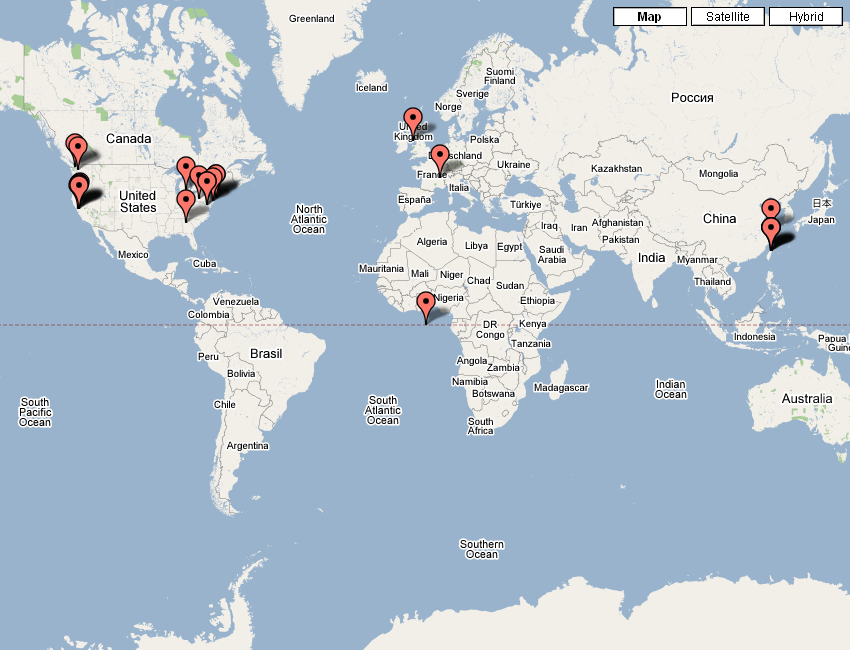
Overview at the right.


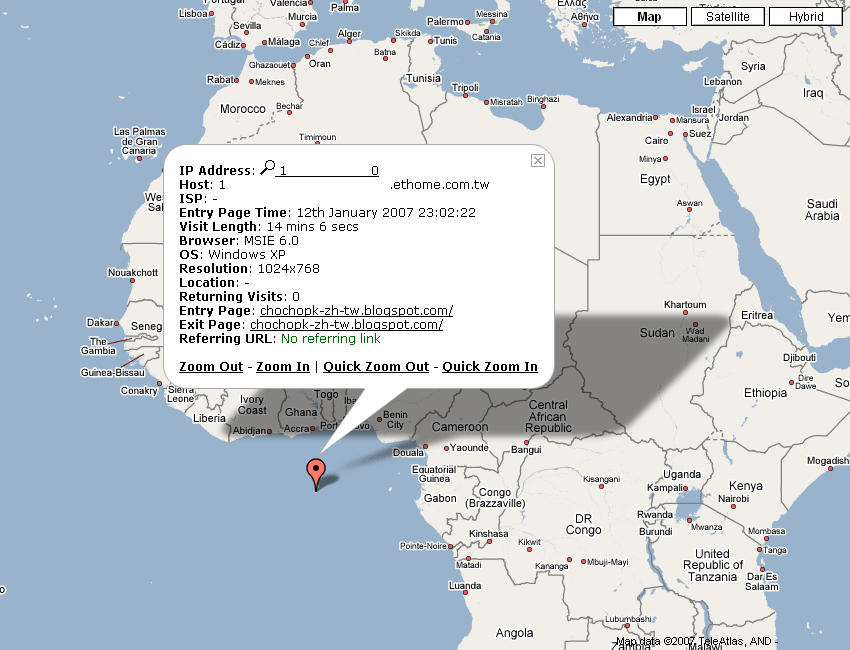
We all know that telecommunication in Taiwan is very developed. But I never know that ET home (東森) has operation in the Gulf of Guinea.